Indicators Lifecycle Management
Introduction
OpenCTI enforces strict rules to determine the period during which an indicator is effective for usage. This period is defined by the valid_from and valid_until dates. All along its lifecycle, the indicator score will decrease according to configured decay rules. After the indicator expires, the object is marked as revoked and the detection field is automatically set to false. Here, we outline how these dates are calculated within the OpenCTI platform and how the score is updated with decay rules.
Decay rule is selected on indicator creation
When a indicator is created on the platform, the decay engine search for the rule that applies at the time the indicator is created. This decay rule is stored along with the indicator: it means that only new indicator created are impacted when decay rules are changed or created.
Setting validity dates
Data source provided the dates
If a data source provides valid_from and valid_until dates and he indicator is elligible to be managed by a decay rule, the platform will change this valid_until with the one calculated by the Decay rule.
When an indicator is created as already revoked, the decay rule is not computed.
Fallback rules for unspecified dates
If a data source does not provide validity dates, OpenCTI applies the decay rule matching the indicator to determine these dates.
The valid_until date is computed based on the revoke score of the decay rule : it is set at the exact time at which the indicator will reach the revoke score.
Past valid_until date, the indicator is marked as revoked.
Score decay
Indicators have an initial score at creation, either provided by data source, or 50 by default. Over time, this score is going to decrease according to the configured decay rules. Score is updated at each reaction point defined for the decay rule matching the indicator at creation.
Example
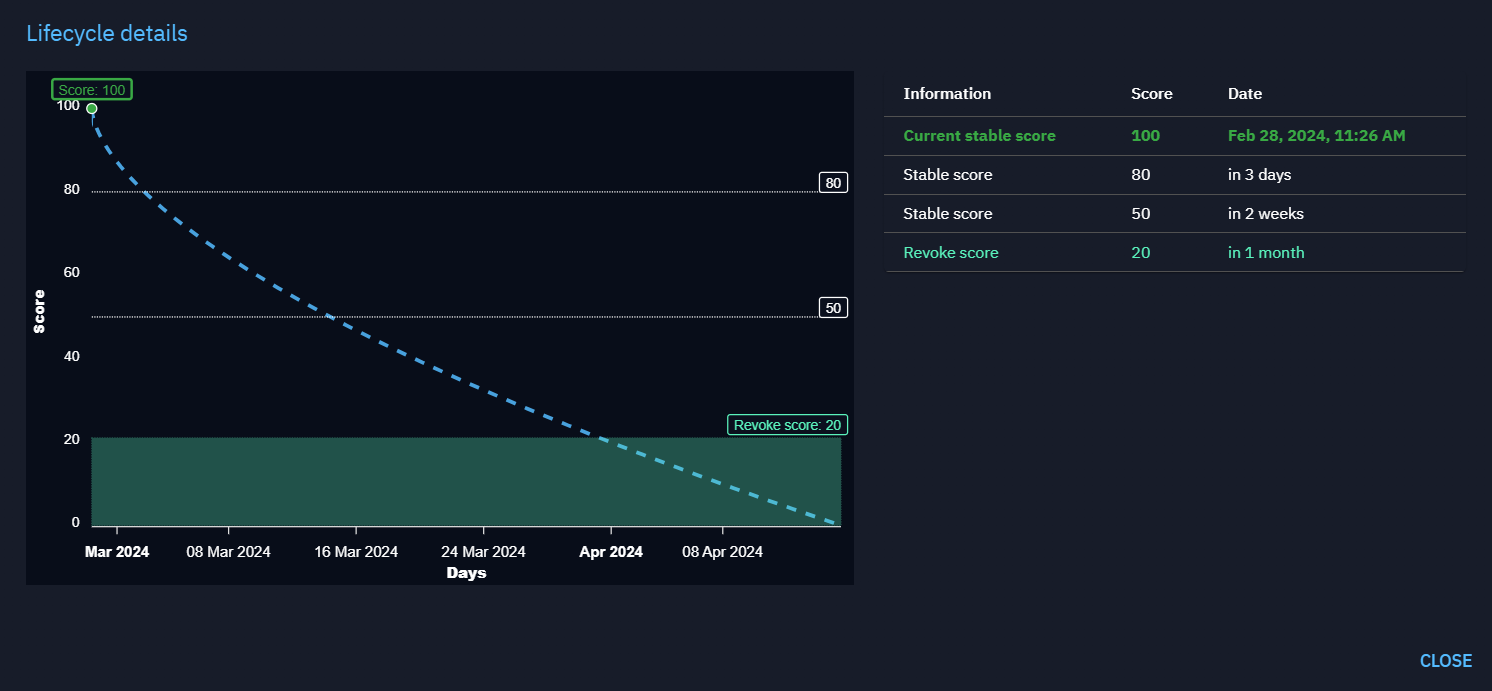
This URL indicator has matched the Built-in IP and URL decay rule. Its initial score at creation is 100.
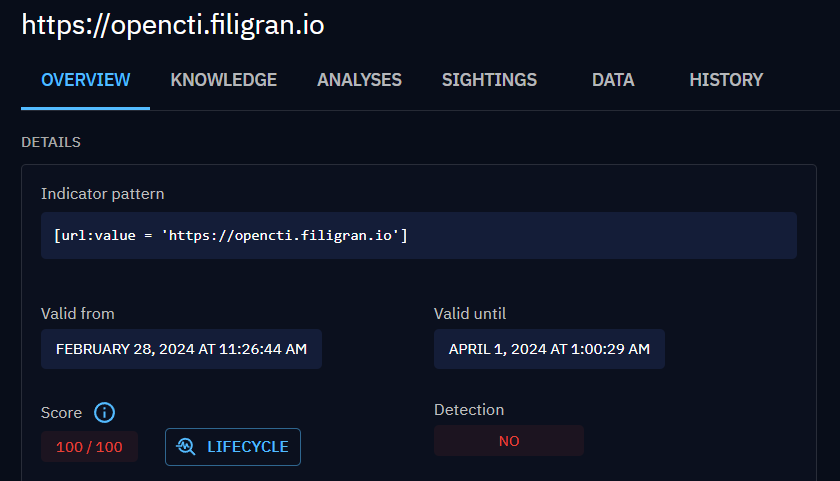
Right next to the indicator score, there is a button Lifecycle which enables to open a dialog to see the details of the indicator's lifecyle.
How the decay behave on indicator updates
The decay rule is a mathematical computation based on:
- valid from
- indicator score
- being revoked or not
There is two ways to update an indicator: either through an update, or ingesting an indicator that already exists in the platform upsert, more information on deduplication page.
Upating score
Updating score restarts a decay lifecycle computation with the decay rule that is already stored in the indicator. It means that the valid until date is updated along with a score update.
Updating the revoke state
- Updating an indicator and moving revoked to true: means that the decay manager will ignore the indicator. The score is automatically updated to be at least at the revoke score of the decay rule that applies, or zero if no decay rules applies.
Example: My indicator has a revocation score at 20, while its score is currently at 80. When revoking to TRUE, the score of the indicator will be at 20.
- Updating an indicator and moving revoked to false: means that the indicator must be valid given the decay lifecycle. If there is no score update along with the revoke update, the score is automatically updated to be the score at indicator creation, or if there is no decay rule 50. The valid until is then computed with this new score value.
Examples:
Update with REVOKE = FALSE: My indicator is currently revoked, with a score of 20. My IOC is under a decay rule. It has been created with a score of 90. When switching revoked to FALSE, the new IOC score is 90
Update with REVOKE = FALSE AND Providing a new score: My indicator is currently revoked, with a score of 20. My IOC is under a decay rule. It has been created with a score of 90. When switching revoked to FALSE and giving a score of 80 in a single operation, the new IOC score is 80.
Update an IOC without decay rule: My indicator is currently revoked, with a score of 20. My IOC is not under a decay rule. It has been created with a score of 90. When switching revoked to FALSE, the new IOC score is 50.
Managing concurency updates from distinct sources
In some case, several sources have different values for one given indicator and keep erasing each other score. As all decay data is computed everytime a score is change, there is a circuit breaker:
- if a source has already done an update with same score in the indicator life, the update is ignored.
Example:
Source A updates an indicator's score with score = 40.
Source B updates an indicator's score with score = 35.
Source A updates once more the same indicator's score with score = 40. This last update won't be permitted.
If Source A would have updated any value different from 40, it would have been accepted.
Conclusion
Understanding how OpenCTI calculates validity periods and scores is essential for effective threat intelligence analysis. These rules ensure that your indicators are accurate and up-to-date, providing a reliable foundation for threat intelligence data.